Monday
Liquidation of Otwock
Sunday
Rosh Hashanah at Grandma's Apartment
Here is a link to another video of Grandma that you can view on YouTube. Grandma talks about anti-Semitism after the war and the murder of her brother. Click HERE.
Tuesday
RELATED STORIES
Sunday
SAMPLE CHAPTERS
CHAPTER 1—BROOKLYN
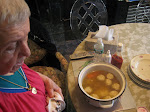
“They murdered my mother,” Grandma told me, slamming her knuckles against the dining room table. I stopped scribbling in my notepad and saw that her tear-shaped eyes were wet. Before Grandma had mentioned her mother’s death, I was asking questions like an objective journalist; but now, I was speechless and my mouth tasted like cotton.
“How did…” was all I could think to say, uncertain as to where I was going with the question. Neither of us said anything. I put down the pen and picked up a spoon, but I couldn’t eat. I just stirred at the soup that Grandma had ordered in from the diner. She hadn’t cooked since Poppy died.
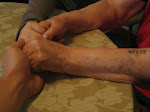
“My mother’s hand wouldn’t let go of mine,” Grandma said, clenching both of her hands together to show me how their fingers had locked. “I needed to run, but my mother’s grip… It was too tight. I don’t know how it happened, but I got free and ran to the barn. Can you believe it?” she asked me and then pressed her lips together to smother a cry. “I left my mother there.”
The refrigerator buzzed in the background. I wanted to tell her that it wasn’t her fault, or that there was nothing she could have done. But I could only gulp.
“In the barn I picked up a chicken,” Grandma added. “I didn’t know what to do. I just ran from the barn with this chicken.”
I looked into my soup bowl—the white chicken wing was staring up at me from the broth. I pushed the bowl toward the center of the table, unable to take another bite. I washed away the cotton with some seltzer, wrote what Grandma had said, and touched the five green numbers tattooed to her arm.
“I need to take a tranquilizer,” she announced.
But Grandma hadn’t always been so forthcoming about her life. When I was a kid back in the 1980s, Grandma and Poppy had kept their stories sealed.
As a child, all I really knew about my grandparents’ Holocaust was that Poppy was the only person to survive from his family and Grandma and her cousin Helen were the only two to survive from theirs.
On the weekends that my parents left me with Grandma and Poppy, I was constantly investigating, hoping to uncover some locked away secret from their past. I would dig up the high-powered aviation binoculars from beneath the pungent rush of mothball-scented sweaters and then perch myself on the cement terrace cradled above Brighton Beach, while Poppy sat inside at the kitchen table calculating the costs of his business. I pretended to hone in on the half-naked beachgoers below and the old-timers hording every last boardwalk bench; and when Poppy was completely distracted with his numbers, I turned the lenses on him to try and magnify his inscrutable ways.
Other times I sat with Grandma in front of the television, where we’d only watch channel six—a snowy image of the building’s lobby fed to her apartment by the closed-circuit security camera downstairs. It was Brooklyn’s version of cable.
“Grandma, is that someone who belongs in the building?” I would ask. She squinted at the person entering the lobby and gasped.
“Oy,” she yelped as the lobby door opened. “Oy,” again. “Who buzzed them in? Somebody didn’t pay no attention and buzzed them in.” After a few minutes of watching lobby traffic with Grandma, her oying would have you believe that the high-rise apartment building was swarming with murderers. I always sat near the phone in case I had to dial 911, not for the “murderers,” but because I thought Grandma was going to give herself a heart attack; but like most Jewish grandmothers, Hadasa Lederman seemed to find comfort in anxiety.
“Don’t worry, Grandma. I think they used their key.” Like two spies, we sat before the image of the static lobby—she looked for “intruders” and I studied her.
After a few hours of surveillance work, Grandma went back into the kitchen to clump together matzos balls, gefilte fish patties, salmon croquette disks, and the bulbous insides of stuffed cabbage. Poppy went to take a nap on the couch. As Grandma furiously worked and Poppy furiously snored, I crept over to the living room wall-unit. The mahogany fixture served primarily as a display shelf for holiday cards. It also housed all of Grandma’s priceless, never-to-be-used china and silver platters. But I was only interested in one drawer. It was the smallest compartment and it was solely dedicated to Poppy’s habits. Inside, buried beneath a grey electronic garage opener and packets of blue-backed Bicycle playing cards was that coveted, red and white box of cigarettes.
I removed the pack of Marlboros and slinked out to the terrace. I never actually lit one. Instead I’d pretend to inhale huge puffs from the unlit cigarette, while impersonating Poppy. In between mouthfuls of air, I echoed his thick Yiddish accent, the one he was convinced he did not have. “Voos ee doos,” I’d yell to the seagulls gliding by. “I’m from Auschwitz,” I’d remark to the birds, though Poppy wasn’t actually from Auschwitz, he had just been a slave there during the war. But what did I know? At seven years old, all I really knew was that I wanted to be in his shoes, or at least understand where his footprints originated.
“Feh, feh,” Grandma kvetched when she found me with the cigarettes. “Leon!” Hadasa yelled to her husband, startling him from his slumber. “Leon!” Not now, said his flapping hand. “See what Noiach does cause of you! Cut it out with the smoking!” Turning back to me: “This is no good tatehla. Oye broch. Oy gevalt,” she sighed nervously. “Here. Come. We’ll eat instead.”
But the only thing I truly hungered for were the stories behind those faint, haphazard, vein-colored digits tattooed forever on Poppy and Grandma’s arms.
“Not now, tatehla,” Poppy said whenever I asked him about the war. He counted the deck of cards onto the plastic tablecloth, making certain there were fifty-two. He glanced up at me as the cards snapped from the deck like a cracking whip. His wrinkled dimples and quick smile let me know it was alright to ask the question, but informed me that I would never get an answer. “We play.”
“Not now, tatehla,” Grandma said. “You want more lokshun?” Uninterested in my answer, she ladled another giant spoonful of long white noodles into my bowl of yellow broth and parsley bits. Unlike the old adage, curiosity killed the cat, Grandma subscribed to the saying kill curiosity, boredom, and even excitement with more food.
If I ever did manage to whittle out a story, what I received was Grandma’s PG-version of the Holocaust.
“There was this girl in my barracks who took my bowl—this is the bowl we ate and drank out of. Everything. And one night she took a pishy in it. You know, like it was a bathroom. Why?” she smartly asked. If she hadn’t, she would have had to ignore another one of my endless questions or finally delve deeper into that crypt of Holocaust secrets. “Because she didn’t know what she was doing. They treated us so bad. What did I do? I had to eat from the bowl. Otherwise I wouldn’t eat. Noiach, more soup?” Grandma asked me, interrupting her own story. I looked at the yellow broth and shook my head no. She walked back to the kitchen and placed something on a dish. “Here tateh sheine. Eat,” she said and handed me a plate with a large grey lump of gefilte fish sliding around on it. It looked like a child’s organ. She then smeared a fuzzy purple blob of horseradish on top. “Eat.”
“Grandma, can you tell me…”
“Eat, tatehla. Eat.”
When my questions remained unanswered, I went into my grandparents’ bedroom and gazed at Grandma’s family portrait, which hung above the light switch like a page torn from an obituary. Thirty-something people—babies, adults, little brothers—all murdered. Thirty-something stories that all began and ended the same way.
“What do you want I should say? That’s a cousin, an uncle, mine brother. Dead, dead, dead. There were more at the house that day, but they couldn’t fit in the picture. They’re all dead,” Grandma told me.
I read the smiles of my exterminated relatives like one reads the untimely dates etched into tombstones. They were gathered around the Seder table in my great-great grandfather’s home. It was a family tree chopped down at the base. Grandma was the last little branch clinging to what was left of the stump. Sitting at the head of the table were her parents, David and Chana. Her older brother, Shmuel, was well dressed and off to the right. Grandma’s pudgy arm popped out from a white-collared black dress and she clutched the arm of her youngest brother, Shama, a cute, disheveled child who appeared out of breath, probably from playing in the yard with cousins moments earlier. His collar was unkempt, his hat tilted too far off his tangled hair. My brother Jake looked like his reincarnate.
Although Grandma appeared happy in the photograph, something in her nervous expression foreshadowed it all.
She was the only one in the picture whose story ended differently. I was determined to uproot those memories.
But Grandma never answered my questions, not when I was a boy; she just fed me to quell my curiosity. When my father and his sister, my Aunt Anne, were children, Holocaust stories were like three meals a day. With genocide indigestion, they went to bed frightened and awoke an hour later from another Holocaust nightmare. Of course, my grandparents raised their children through a series of trials and errors. They were never actually taught how to raise kids. Anyone who would have taught them such things was reduced to ashes. The haunting dreams stopped only when Leon and Hadasa buried the stories from their children.
Cousin Helen’s eldest daughter, Alice, who was around my father’s age, made it further through life stomaching the Holocaust. For eighteen years, she fed her inquisitiveness with stories of familial genocide. One afternoon, during the late 1960s, Alice visited a Holocaust exhibit in the Huntington Hartford Museum at Columbus Circle. She walked through the valleys of enlarged photographs mounted to the walls. Each still-frame echoed the aura of liberation: fear, confusion, and nothingness. There was one photograph, however, that liberated Alice from her desire to unbury her parents’ war. On the wall hung a pile of naked, emaciated corpses. They were stacked like a bonfire. Alice turned from the image as her eyes welled up. She no longer hungered for her parents’ memories.
And it went like that. My grandparents did all that they could to survive the camps, my father and aunt did all they could to block it out, and I, unwillingly, grew up protected from the Holocaust. Poppy and Grandma kept their past as mysterious as the permanence of the green ink tracing down their arms. Yet, if someone asked me when I was a boy, “tell me something about yourself,” my grandparents’ story, which I knew almost nothing of, was ingrained in my identity.
“My grandparents survived the Holocaust,” I managed to squeeze into almost any conversation.
Just as Poppy and Grandma were forever forced to bear those numbers tattooed to their arms, I was determined to tattoo the Holocaust into everyone’s memory. As I grew older, innocuous facts in history classes and works of literature gently brushed over my grandparents’ Holocaust—the genocide of my people—but they never quenched my desire to uncover the horrors Hadasa and Leon Lederman kept buried in their minds.
CHAPTER 2—SUPER POPPY AND HIS SIDEKICK THE MESHUGGE, LOVING GRANDMA
The summer of 2006 was coming to an end, I was in my mid-twenties, and I decided to visit the Jewish Museum in New York City. On display were comic books created by Jewish artists, many of which dated back to the 1940s. I watched proudly as Captain America, in the premier issue, cracked Hitler in the face and contorted the murderer’s smug mien as easily as knuckles kneading dough. Useless Nazi bullets ricocheted off of the Captain’s shield. As Hitler fell across the page, he appeared for once defeated. I could imagine Captain America’s red-gloved fist to be my own.
In the next portrait Superman, the Man of Steel, bent Nazi cannons on the cover of the 44th issue of Action Comics. He was hardly fazed by the pebble-sized ammunition aimed at his massive frame. Mr. Faster-than-a-speeding-bullet was like Moses in disguise. Both were cast off by their parents, becoming saviors of their people—one for Earthlings and the other for the slaves in Egypt. Even Superman’s Kryptonian name Kal El means “all that is good” in Hebrew. On every wall of the museum, superheroes, from the Human Torch to Sub Mariner, combated Nazis.
But the pride that I felt from looking at those old comic book covers turned to anger, for the artwork only highlighted the world’s indifference. While American Jewish comic book artists and writers fought the Nazis with onomatopoeias and plotted out battles on grey-stained palettes, the elected captain of America, Roosevelt, did nothing. My family died because only cartoons waged war on Hitler.
The real superheroes were murdered in Auschwitz and Majdanek and Treblinka and every other camp and ghetto and street corner in Europe. Yet I was certain that I had known one superhuman when I was a child, a man that had risen like a phoenix from the ashes of the crematoriums. However, he had kept the Holocaust stories inked only in the tombs of memory, as cloaked as a superhero’s secret identity.
***
“Make a muscle,” I demanded of Poppy as the two of us sat on the grey couch in the television room watching as some phony superman bounded off the top turnbuckle and body slammed his opponent. Poppy rolled up his sleeve and balled-up his bicep. I wrapped my ten-year-old fingers around the stone appendage and did my best to crush it.
“Poppy’s not weak, tateh sheine,” he would say after I tired out. He was like Popeye the Sailor Man—short, powerful, a smoker with a deep scratchy voice—but with a Yiddish accent. “Kine hora,” he affectionately announced, complimenting my best effort. It was the early 90s, and I never would have imagined he’d be dead by the end of that decade.
He rolled down the sleeve of his white cotton v-neck T-shirt—at the site of the “v,” thin wisps of chest hair squiggled out—and he went back to observing the match on the TV. We loved watching the World Wrestling Federation together. It offered me the chance to bond with Poppy, but I think he liked how the brutality on television kept his mind at bay.
Poppy’s face was handsome, but rough to the touch. Kisses felt like sandpaper. The etches that his dimples once made were now engraved ever so gently beneath his light white bristle. His nose was a thick pyramid, and beneath it was an ever-present smile. In fact, it was more like a smirk—the same dubious grin that stretches across the face of a lion. His arm was stamped with his number from Auschwitz, and it always reminded me that inside his mind was a bottled up tragic tale; yet his blue eyes told another story. They seemed to wash away the violence of memory.
“Hey Poppy, did you ever fight any Nazis?” I asked, bobbing for Holocaust secrets.
“They couldn’t beat your Poppy.” That was the length of a good response.
“But Poppy, I heard my dad talking about you and a fight and a boat. What’s that about?” Poppy didn’t say anything, he just smiled and placed a kiss on the top of my head. “I heard a sailor said something bad to you, you know, about being a Jew and stuff, and you nearly killed him. Is that true? Did you nearly kill someone?” I asked, pushing against him as if to squeeze out the answer.
“All you need to know is that Poppy loves you, sheine yingle. No more questions, we’re missing the match.” One of the wrestlers had just clotheslined his opponent and Poppy began shouting at the unconscious fighter. “Get up, get up. Ahh, he’s farkakt.”
I wanted him to confirm the story, I wanted to uncover those secrets, but I realized this wasn’t going to happen. So I uncovered something else. I reached up to his combed-over white hair and flipped it off of his head, revealing his bald spot. He quickly reset the white flap to its unnatural position and prepared himself to scold me. But as soon as we made eye contact, he smiled.
“Poppy loves you, sheine yingle,” he said and we went back to watching the fight.
When we weren’t sitting in the television room, we were dealing out cards for our twentieth hand of Kalookie or Casino.
“It’s too easy. I win again,” I announced. Poppy shuffled the pile of worn out cards and smiled. “Let’s play another game of Casino,” I challenged arrogantly. “Grandma, guess who won again?”
“Ooh, you’re so smart Noiach. You wanna take a break to eat?”
It was a game of algebra and card counting. I could add fine, but I could never follow all of the suits and numbers I was meant to be tracking. Yet, I always won. Poppy, with the mind of a mathematician and the skill of a Las Vegas card counter, never won. I thought I was a genius. Eventually, I learned otherwise.
“Okay Noiach, so you make five spots in your head,” Poppy explained. “Aces, kings, queens, jacks, tens. You also remember spades. Then you count them. One of something. Two of something. Up to four.” And as I learned to count cards through confusion and accents, I scratched at the slight facial hair that began to bud on my chin and I watched as my winning percentage plummeted. At first, I couldn’t comprehend how improving in math and developing strategy could negatively effect my win to loss ratio. Then again, it took awhile to understand why I always won that last game.
After handing me defeat, Poppy pulled a wad of cash from his pocket and began peeling off bills and placing them on the table. “Noiach. Take. Get something nice sheine yingle. Poppy loves you,” he added, as I hesitated to take the money.
“Did they let you play cards in Auschwitz?” I asked.
“Poppy loves you,” he said again.
“Poppy loves you,” was his favorite line. It was never weird in the tiny family he created, but unheard of between male relatives on my mom’s side. Yet our phone conversations were not much longer than “How are you tatehla?” and “You know Poppy loves you.”
“I’m good Poppy. So how have you…”
“Noiach,” Grandma interrupted, having been handed the phone before I could inquire about his life. “What’s mommy cooking for dinner?”
When the entire family gathered at my grandparents’ apartment it was comfortable chaos. There was my father Sam, mother Paula, brother Jake, Grandma Hadasa, Aunt Anne and her two daughters, Elyse and Shari. But Leon Lederman was the glue of the Lederman clan.
During holidays we sat around the dining room table, inundated with trays of Grandma’s cooking, and argued. “Tax deferred annuity is a must.” “When I’m ready.” “When she’s ready.” The meal was only interrupted by the passing of dishes or Jake’s mischief.
“Poppy, did it hurt when they put the number on your arm?” I whispered while everyone else was slurping up their soup. I touched the six digits on his forearm, until his rough hand grasped my own. He smiled and winked. “Sheine yingle,” was all he said.
“Oy,” Grandma shrieked as she delivered the second platter of kreplach for the soup. “Meshugge,” she yelled through the oak table. My brother, who was four years younger than me, was beneath it. He spent dinners crawling along the ocean of blue carpet below the table, pulling at legs and shoes, avoiding the Jewish feast. “Tateh sheine, you’re too old for this meshugas,” Grandma yelled, but Jake refused to emerge. “Sit like a mensch.” There was no time to see if her words prodded him from below, she was right back to business.
Grandma turned the kitchen into a one-woman factory. Manning the stove in her floral print housedress, the loose skin of her arms wobbled like a rooster’s wattle as she stirred, mixed, and flipped. Somehow, her carefully permed hair would hold strong against the humidity in the kitchen (and withhold the insistency of her grandsons’ hands, since my brother and I were infatuated with compressing her perm like a spring). From the dining room table, we listened to the orchestra of clinking pots and pans, and of Grandma kvetching.
“I do all this cooking and nobody eats.” Though nobody could argue with mouths full of food.
When the gefilte fish was served, my father would think back to his first pet.
“When I was six,” my father began, “I came home and saw a carp swimming in the bathtub. I was so excited because I thought it was my new pet. I quickly changed into my bathing suit,” he smiled and paused, “only to find Grandma scaling it in the kitchen.”
If the dinner table wasn’t noisy enough, the non-verbal din created its own fiasco: laughing, greptzing from seltzer, and sneezing. Grandma coached us through the feast as though it was an eating contest, and when we choked or coughed, she coached us through that, too.
“Up, up, up,” Grandma instructed the cougher. She was already in mid-sprint from the kitchen. The victim (at least that’s how Grandma treated them) held their arms up above their head as though they were being robbed and then whack, whack, whack went Grandma’s hand, paddling the cougher’s back. If she heard a sneeze, she provided so many instructions that it seemed as if sneezing required a manual. “Gezunt heit. Quick tatehla pull your ear. Oye vecht. Oye broch. Do it again.” I winced at bodily functions and awaited the pulls and zetzes. I even half-expected Grandma’s hand to pound my spine when I asked for a dish, since half of them began with coughing, phlegm-producing sounds—knishes, kishka, kougle, kreplach, kasha, kompot, cake, challah.
“Cholent please.”
“Quick, pull your ear.”
Grandma turned me into Pavlov’s dog and bodily functions became my bell. My hand cracked against backs at the sound of a cough and fingers went for ears as faces hinted at a sneeze. It was this culture that certainly had me explaining myself to the school principal on numerous occasions.
When Grandma wasn’t spine-thumping or ear-wrenching, she was seeking out empty plates. A bare plate was a signal for more food. Even from afar Grandma would know when to spring up on you with her serving spoon. She could hear the scraping of a fork against an empty bowl like a dog perking up for a dog whistle.
Scrape, scrape, BAM.
She was always armed with her caldron of kreplach or a tray of matzos balls. Even when we were stuffed, Grandma would confuse us with paradoxical language. “Are you full? Eat.” She wielded a shmate, and always managed to swoop in when something spilled. Drip. “Oy.” Drip. “Oy.”
But she would never join us at the dining room table. Not once. Auschwitz and Majdanek, it seemed, had trained her to never break from her work.
Poppy, on the other hand, was always seated at the head of the table smiling.
His sisters were murdered. His mother was murdered. His father murdered. Cousins. Aunts. Uncles. Grandparents. Friends. Neighbors. Murdered six million times. But he seemed to find peace every single holiday around that dining room table. Every so often, he’d reach a hand out to touch his nearest grandchild (and all the grandchildren wanted to sit near him), and when the meal came to an end, and the pandemonium simmered down, Poppy would retire to the television room.
On the last day of 1999, when I was eighteen years old, we buried Poppy with our hands in a maze of Jews. Each handful of soil I had placed on his casket felt as though I had buried the Holocaust, too. I was beleaguered by what seemed like six million graves. As I left the cemetery, I realized I would never again be able to hear “Poppy loves you, sheine yingle,” or say, “make a muscle,” or be told “not now” when I wanted to know his story about living through dying.
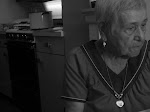
His death became the end of that family. My brother stopped crawling on the floor. My cousins stopped talking to my aunt and Grandma for a number of years. And Grandma lost her will to go on, wishing to join her husband every day, though her concentration-camp-trained body would not allow her this. Instead she tried her best to wither away at the dining room table where Poppy and I once played cards. Around her neck she wore a gold plate tattooed with an image of her deceased husband. His white hair wrapped around his head like a halo. His blue eyes were like precious stones. Around Grandma’s neck he swung like some Jewish saint—the Saint of Fargesn—the Saint of Forgetting. Every time I encountered Poppy’s eyes on that gold necklace, I felt as though I was moving further and further away from him. I felt as though I was forgetting the Holocaust.
But in fact, I had never known the Holocaust, and as the years passed, the curiosity from my youth resided in me like tremors in the ground after an earthquake. My grandparents’ Holocaust beckoned me to finish digging it up.
“Hey dad,” I said from a phone booth in Poland when I was off traveling the world in 2004. “I stood in Poppy’s yard today. I found the house.”
When I returned home, my aunt called. “Noah. Daddy told me what you found when you were in Poland, maybe you want to take a look at the tapes.” From the dusty reaches of her closet, she had exhumed hours of testimonial videotapes my grandparents had recorded years ago with Steven Speilberg’s Shoah Foundation—a project to document the stories of survivors and witnesses of the Holocaust.
I watched the tapes of my grandparents and wrote furiously as they revealed secrets from their past. After the tapes ended, I stared down at my notepad, which was deluged with a web of questions. I realized how little I knew about Poppy and Grandma’s Holocaust, and how others, those with no personal stake in my people’s tragedy, were bound to let it slip from memory.
The following year, I became a teacher, and I witnessed this disconnect with my high school students, descendants of slaves and victims of murderous regimes.
“Does anyone know what the Holocaust was?” We were about to begin Elie Wiesel’s memoir, Night. After a few moments of silence, one student raised his hand.
“That Jewish thing, right?” He was the only one in the entire class that came close.
It was then that I made a promise to revive the two stories that my grandparents had allowed to disintegrate like ashes. With a notepad and an arsenal of questions, I joined Grandma at the kitchen table to try once more to open up the Holocaust vault.
EXCERPTED FROM CHAPTER 8—KARCZEW: 1942
One Nazi sauntered over to a cluster of helpless victims. Women clung to their children, fathers shifted to block their families from the predatory eyes of this drunken German. You, his finger said. The victim rose from the line and walked over to the Nazi who was holding a long black truncheon at his side. When the Jewish man stopped the German thrashed him with the wooden club until his body dropped to the ground as though he had instantly vanished and all that was left was a pile of clothes. With each hit, those clothes bled and bled and bled until the Nazi ambled back to where he had left his cigarettes and beer.
By the afternoon, after the sun spent the day pummeling the eight thousand Jews in the Umschlagplatz, the cattle cars arrived to swallow them up. Leon watched from his hiding place. Cries and pleas were muffled as the heavy wooden doors slammed shut on the eight thousand. The Nazis responded with gunfire and doused those inside with lime. Truncheons unleashed on those that refused to hand over their baggage. They were bloodied, stripped of their possessions, and in the end, stuffed into the wagons just the same.
“I’m going,” Leon said and ignored whatever appeals his friends offered. He snuck down to the long chain of wagons and was pushed into one of the cattle cars with nearly one hundred and twenty other Jews. Inside there was enough space for maybe a few cows, not one hundred and twenty people.
When the trains were filled beyond capacity, the remaining four thousand Otwock Jews were marched off into the woods and executed. Their gold teeth were removed and their bodies were shoved into the pits that they dug beforehand.
Otwock was now completely Polish. Its sole inhabitants wielded axes and hacked down doors to homes once owned by Jews, ravaging through the last belongings of their former neighbors who were hours from the gas chambers. The Polish children and their mothers played and splashed in the gentle currents of the Swider, while others tongued their ice cream along the riverbank. The street was littered with broken furniture and dead bodies.
By nightfall, the train crawled out of the station.
“Chana. Esther. Mama,” Leon shouted in vain.
The sappy smell of pine combs curling off the winds from the river and the intoxicating aromas of acacia were masked in the cattle car by diarrhea. The locomotive was a dark and crowded tomb. Now and again the train stopped and the doors slid open. Gunfire exploded. The doors closed and the train crept forward again. Sometimes the doors would not open; the bullets entered through the openings above.
Leon slinked through the mass of bodies to the bars on the window. He reached down to his waist and carefully removed a long sliver of wire that he had worn like a belt. Leon coiled the wire around his left hand and slipped the wire through the barred window overhead. Wrapping it tightly around his other hand, he dragged the thin cord back and forth against one bar for hours.
The heat, even at night, was unbearable. Thirst poured through the wagon. Bodies slumped against one another. There was no room to fall. Even the dead stood.
Leon noticed that the wire cutting through his palms was also cutting through the cage; but the train was nearing Treblinka. The sobs and prayers intensified. Others buried faith right there in that cattle car.
Then the bar gave out.
He looked around the cattle car once more for his family, but the darkness consumed everything.
As quickly as his tired arms allowed, Leon tied the cord back around his waist, hoisted his frail frame up through the hole, and slithered halfway through the opening. Every vein in his arm pumped violently. His entire body shook. Draped from the window of the cattle car, ten feet from the moving ground, Leon felt unequipped to handle the fall. If the drop did not end his life, the machine gunner atop the roof could. But entering Treblinka was certain death. This moment, hanging from the cattle car like a blanket drying, he at least controlled. Leon inched the rest of his body through and in one motion launched himself from the cattle car, tumbling into the night over shards of ground.
In a Polish field somewhere between Otwock and Treblinka, Leon Lederman watched as the train crept toward the gas chambers with his mother, father, and four sisters inside.
Life had taken a new purpose—some way, there would be vengeance. There was no choice now but to return to Karczew. He was seventeen years of age.
